

Global Trends in Robotic Welding Automation: TOPTEK's Industry-Leading Systems
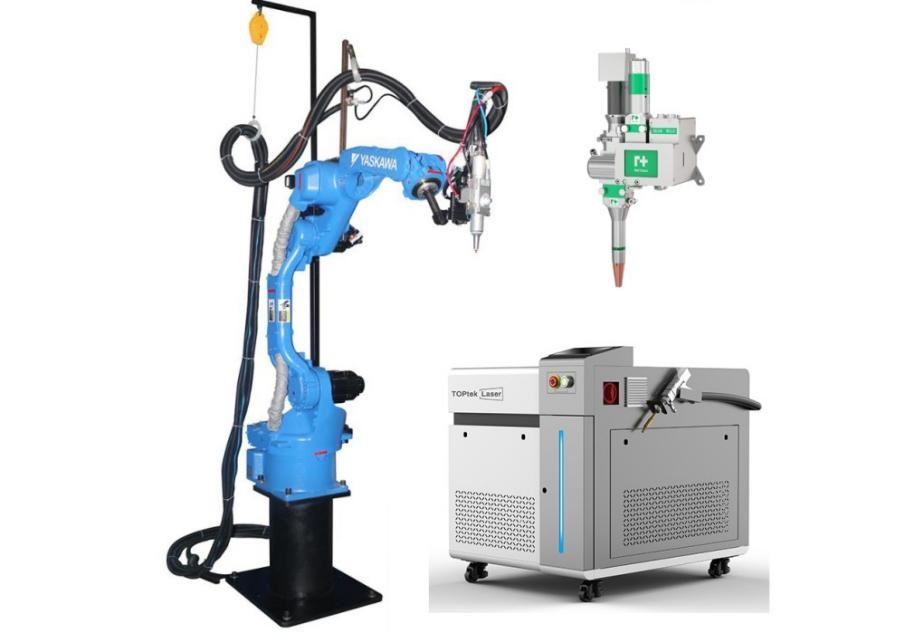
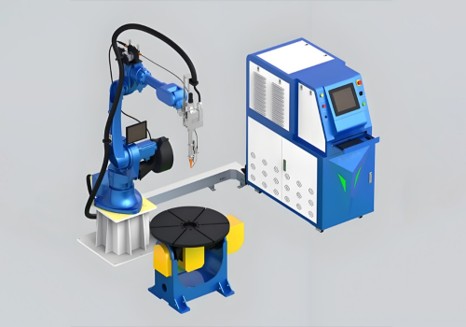
These three forces—skilled-labor scarcity, occupational-cost escalation, and high-mix production demand—are driving adoption of flexible robotic laser welding cells across industries from automotive subcontracting to structural steel and pressure-vessel fabrication. TOPTEK LASER has spent more than a decade developing Industry Leading Systems for Robotic Welding Automation that address each of these pressures with practical, production-ready platforms. The company's robotic welding portfolio—covering six-axis arm integration, servo-driven positioners, laser sources, and built-in process libraries—reflects both deep field experience and a design philosophy aligned with European and North American engineering standards.
Trend One: Labor Reduction Through Integrated, Expandable Architecture
A Single-Source Cell Ready for Future Sensors
When a fabrication shop first automates welding, the immediate goal is straightforward: move the arc away from a human operator. But the longer-term value of a robotic cell depends on how easily it can absorb new capabilities—seam tracking via laser vision, adaptive force control for variable fit-up, or real-time quality monitoring—without requiring a system redesign.
TOPTEK's robotic laser welding cells integrate the six-axis arm, servo-driven positioner, laser source, and control electronics from a single production base spanning more than 35,000 square meters in Jinan, Shandong Province—China's largest laser manufacturing cluster. Because the control architecture is developed in-house, external-axis I/O channels are reserved at the system level, allowing end users to add vision sensors or force-feedback modules as production requirements mature. This matters in practice because retrofitting sensor interfaces onto a cell built from mismatched vendor subsystems typically involves custom wiring, protocol adapters, and revalidation—costs that can rival the price of the sensor itself.
Built-In Process Library to Cut Programming Time
Reducing headcount on the welding line only works if the robot can be programmed quickly enough to keep up with a changing product mix. TOPTEK's systems ship with a process parameter library pre-loaded for carbon steel, stainless steel, and aluminum alloys. Operators select the material and input the plate thickness; the system returns a recommended set of line energy, focal distance, and wire-feed values as a starting point. Fine-tuning still happens on the shop floor, but the library compresses the gap between loading a new part program and running the first acceptable weld—a tangible response to the high-mix scheduling pressure that many fabricators face daily.
Trend Two: Quality Traceability Through Welding Data Recording
From Weld Log to MES Integration
Automotive tier suppliers, structural-steel contractors working under EN 1090, and pressure-vessel shops governed by ASME codes share a common requirement: every weld must be traceable to a specific set of parameters. Manual logging on paper travelers is slow, error-prone, and difficult to audit. As robotic welding automation systems replace manual stations, the expectation is that the cell itself should generate the traceability record automatically.
TOPTEK's in-house control platform records laser power, travel speed, wire feed, and shielding-gas flow for each weld segment in a structured data format. These records can be exported or linked to a plant-level manufacturing execution system, giving quality engineers the ability to correlate any post-weld inspection finding with the exact parameters used at that point in the seam. For shops pursuing or maintaining ISO 3834 welding-quality certification, this capability reduces the administrative burden of compliance while improving the reliability of the underlying data.
Factory Validation Before Shipment
Traceability starts with a known-good baseline. Each TOPTEK robotic welding cell undergoes full-load commissioning at the factory, where the complete system runs simulated production weld paths under sustained thermal load. Power stability, positional repeatability, and axis synchronization between robot and positioner are verified and documented before the cell is crated. This pre-shipment validation establishes the reference dataset against which field performance can later be compared—a step that simplifies both initial acceptance testing and ongoing preventive maintenance.
Trend Three: Cross-Border Service Accessibility
Overseas Spare Parts and On-Site Training
Purchasing a robotic welding cell from China and installing it in a European or Middle Eastern facility raises a practical concern: what happens when a component needs replacement or an operator needs retraining? Shipping parts internationally can take weeks, and flying in a technician on short notice is expensive.
TOPTEK operates service centers in South Korea, Turkey, and Europe that stock commonly needed spare parts and provide on-site installation, commissioning support, and operator training. With over 10,000 laser systems now running across more than 80 countries and regions, this regional presence shortens the response loop significantly compared to a purely export-based model. For a robotic welding automation factory at this scale, maintaining forward-deployed service points is not a luxury—it is a structural requirement for keeping customer uptime high.
Engineer-to-Engineer Communication From First Contact
Every TOPTEK sales representative comes from an engineering background. When a customer calls to discuss joint design, fixture clamping strategy, or heat-input limits for a specific alloy, the conversation happens in technical terms from the start. This approach reduces the back-and-forth that slows down project scoping and helps ensure that the cell configuration delivered to the shop floor matches the actual production need—not just a catalog specification.
Component Quality and Assembly Standards
The performance ceiling of any robotic welding automation systems is set by its weakest component. TOPTEK sources laser generators and optical welding heads from international premium brands, and drive components follow the same sourcing policy. Incoming parts pass through documented inspection protocols before entering the assembly line, and finished systems undergo power-stability and beam-quality verification prior to shipment. With a design philosophy aligned to leading European and North American standards, the company positions its hardware for high-end markets—Europe, North America, the Middle East, Japan, and South Korea—where equipment is expected to run continuously with minimal unplanned downtime.
Matching Robotic Welding Systems to Real Production Needs
The three trends reshaping welding shops—fewer available welders, stricter traceability demands, and fragmented product mix—are not abstract forecasts. They show up in daily scheduling meetings and quarterly cost reviews. TOPTEK LASER's response is a robotic laser welding platform built around an integrated and expandable architecture, a process library paired with data-recording capability, and overseas engineering service that keeps the system productive long after installation.
For manufacturers evaluating robotic laser welding for new or existing production lines, TOPTEK's engineering team offers line-assessment consultations and application-specific parameter recommendations.
To learn more or start a project discussion, visit: https://www.topteklasercnc.com
SHANDONG TOPTEK IMPORT & EXPORT CO., LTD.
TOPTEK LASER
email us here
Visit us on social media:
LinkedIn
Facebook
YouTube
Legal Disclaimer:
EIN Presswire provides this news content "as is" without warranty of any kind. We do not accept any responsibility or liability for the accuracy, content, images, videos, licenses, completeness, legality, or reliability of the information contained in this article. If you have any complaints or copyright issues related to this article, kindly contact the author above.
