

Lightspeed Systems Announces Most Comprehensive Screen Time Reporting and Management Solution for Schools

When a district can say 'here's what screen time actually looks like in our schools, by grade level, by campus, compared to districts like ours' that's the beginning of a productive conversation.”
ORLANDO, FL, UNITED STATES, June 29, 2026 /EINPresswire.com/ -- Today at ISTELive 2026, Lightspeed Systems®, the K-12 student safety and digital management platform protecting 23 million students across 31,000 schools worldwide, announced the most comprehensive screen time solution in K-12 education. Built by data scientists exclusively for K-12, the solution spans district-level analytics, student-level reporting, multi-OS device coverage, and parent-facing visibility, giving school leaders everything they need to understand student screen time, communicate it to boards and communities, and create the most balanced and effective learning environments. — Amy Bennett, Chief of Staff at Lightspeed Systems.
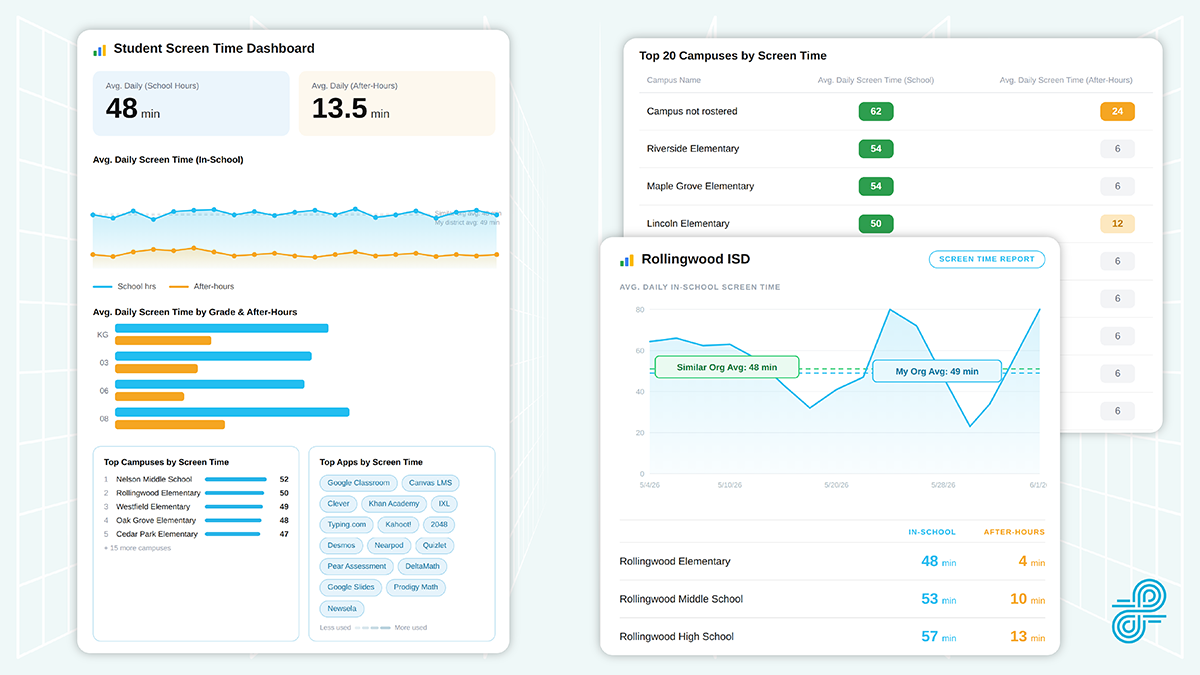
With Lightspeed, school leaders can access comprehensive screen time data without needing to stitch together multiple reports or connect to business intelligence systems. Lightspeed's comprehensive screen time solution includes:
● Average Daily Minutes by Grade Level across in-school and after-hours usage
● Screen Time Trends Across the School Year to spot usage spikes and seasonal patterns
● Top Campuses by Screen Time to identify outliers and start the right conversations
● App-Level Breakdowns showing time spent across instructional versus non-instructional, and approved versus non-approved, applications
● Student-Level Reporting for granular visibility into individual usage patterns
● Peer-District Benchmarks to contextualize local data against like-sized districts
● Multi-OS Coverage across platforms and device types, including native app activity on Windows and macOS devices
● Parent-Facing Screen Time Insights in the Lightspeed Filter Parent Portal with daily and weekly usage summaries, top apps, and in-school versus out-of-school breakdowns delivered directly to families
The announcement lands as screen time has become one of the most urgent priorities in K-12 education, and Lightspeed's national platform data tells a more nuanced story than the headlines suggest. Across Lightspeed-connected schools from January through mid-April 2026, students averaged just 48 minutes of active in-school screen time per day across K-12. Elementary students averaged 35 minutes per day, middle schoolers averaged 57 minutes, and high schoolers averaged 51 minutes, figures that reflect the greater volume of digital coursework and collaboration at those grades. YouTube is among the top concerns for parents when it comes to passive screen time. Among K-5 students, daily in-school viewing averaged approximately one minute. These are not the numbers parents and communities have been imagining, and districts now have the data to share what's happening in their classrooms.
Unlike general-purpose analytics tools adapted for schools, Lightspeed measures active app engagement rather than device-open time and excludes zero-activity days from averages, so reported figures reflect what screen time actually looks like on a typical active school day. It is the most rigorous, purpose-built screen time methodology available in K-12.
"The instinct to pay attention to screen time is right, and parents, educators, and board members are asking exactly the right questions. Too often, those conversations have been based on assumptions instead of facts. When a district can say 'here's what screen time actually looks like in our schools, by grade level, by campus, compared to districts like ours' that's the beginning of a productive conversation and we're excited to facilitate it," said Amy Bennett, Chief of Staff at Lightspeed Systems.
"Districts are standing in front of their boards right now with real pressure to answer questions about screen time, and the data they're working from often isn't reliable or comprehensive enough to back them up," said Jennifer Duer, EVP of Product at Lightspeed Systems. "We built Lightspeed Insight on a methodology developed specifically for K-12, because data that conflates passive device time with active engagement isn't useful to anyone making real decisions. When a technology leader shares these numbers with their community, they can answer the follow-up questions."
Offering helpful tools beyond software, Lightspeed has also released a Screen Time Communications Toolkit for board-ready messaging, data talking points, and community communication resources.
Lightspeed will be showcasing these capabilities and more at ISTELive 2026 in Orlando this week. To learn more or request a demo, visit lightspeedsystems.com/screen-time.
About Lightspeed Insight
Lightspeed Insight simplifies edtech decision-making with the most complete picture of K-12 app activity on the market. It empowers leaders with real-time, actionable data to understand screen time, optimize instruction and app governance, expedite compliance, and cut costs.
About Lightspeed Systems With more than 25 years of serving education, Lightspeed Systems delivers the most in-depth visibility and control to power exceptional schools where students are safe and engaged; technology is compliant and easily managed; and resources are secure and optimized. Purpose-built for school networks and devices, Lightspeed's cloud-managed solutions include the most effective web filtering, student safety monitoring, classroom management, device management, and data analytics software available. Headquartered in Austin, Texas, with a European office in London, UK, Lightspeed serves over 23 million students across 31,000 schools in 43 countries, utilizing 15 million devices.
Amy Bennett
Chief of Staff, Lightspeed Systems
+1 503-891-7956
email us here
Visit us on social media:
LinkedIn
Facebook
YouTube
X
Legal Disclaimer:
EIN Presswire provides this news content "as is" without warranty of any kind. We do not accept any responsibility or liability for the accuracy, content, images, videos, licenses, completeness, legality, or reliability of the information contained in this article. If you have any complaints or copyright issues related to this article, kindly contact the author above.
