

Global Vinyl Sulfone Market: Mexico at 3.7% CAGR as Bodal, Kiri & Atul boost regional leadership
Nearshoring boosts textiles and life sciences demand, turning Mexico’s vinyl sulfone market into a dual growth engine for volume and value
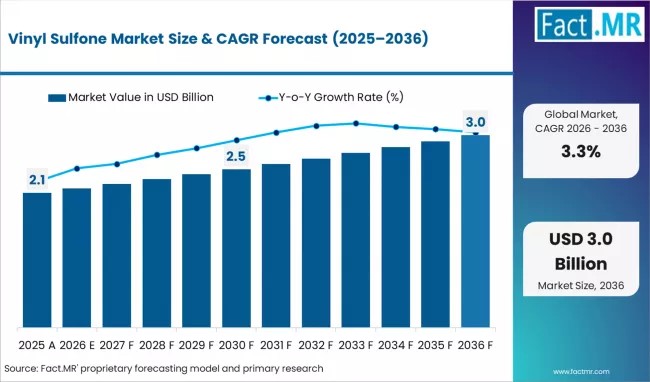
ROCKVILLE, MD, UNITED STATES, April 20, 2026 /EINPresswire.com/ -- According to Fact MR's latest analysis, the Mexico vinyl sulfone market is valued at approximately USD 145 million in 2026 and is projected to reach USD 150 million in 2027, expanding to nearly USD 210 million by 2036. The market is expected to grow at a CAGR of 3.7% (2026–2036), generating an incremental opportunity of USD 65 million over the forecast period.Market transformation is being driven by textile manufacturing nearshoring, increased reactive dye consumption, and a rising shift toward high-purity vinyl sulfone applications in biotechnology and diagnostics. While textile dyes anchor volume demand, life-science applications are reshaping pricing dynamics and margins.
Get detailed market forecasts, competitive benchmarking, and pricing trends: https://www.factmr.com/connectus/sample?flag=S&rep_id=5884
Quick Stats
Market Size (2026): USD 145 Million
Market Size (2027): USD 150 Million
Forecast Value (2036): USD 210 Million
CAGR (2026–2036): 3.7%
Incremental Opportunity: USD 65 Million
Leading Segment: Vinyl Sulfone Monomers (≈58% share)
Leading End Use: Textile/Reactive Dyes (≈49% share)
Key Players: Bodal Chemicals Ltd., Kiri Industries Ltd., Atul Ltd., Shree Pushkar Chemicals, Bhageria Industries
Executive Insight for Decision Makers
Mexico’s vinyl sulfone market is undergoing a strategic bifurcation:
Volume-driven textile demand from nearshored manufacturing
Value-driven life-science applications with higher margins
For manufacturers and investors:
Diversify sourcing beyond Asia to mitigate supply disruptions
Invest in high-purity, GMP-compliant production
Build localized distribution and inventory strategies
Risk of inaction:
Overdependence on imported intermediates and lack of product diversification could lead to margin compression and supply volatility exposure.
Market Dynamics
Key Growth Drivers
Expansion of textile manufacturing clusters due to nearshoring from the U.S.
Rising demand for colorfast reactive dyes in cotton processing
Growth in bioconjugation and diagnostic reagent applications
Increasing specialty chemical consumption in industrial sectors
Key Restraints
Heavy reliance on imported raw materials (primarily from India and China)
Price volatility of sulfur-based intermediates
Stringent environmental and chemical handling regulations
Emerging Trends
Shift toward high-purity vinyl sulfone for biotech use
Adoption of green chemistry and sustainable synthesis processes
Increasing inventory buffering strategies among buyers
Development of localized chemical distribution networks
Segment Analysis
By Product:
Vinyl sulfone monomers dominate with ~58% share, driven by large-scale textile dye applications.
By End Use:
Textile/reactive dyes lead with ~49% share, while bioconjugation & life sciences is the fastest-growing segment.
By Form:
Liquid/technical grade accounts for ~71% share, preferred for industrial processing efficiency.
Strategic Insight:
While textile applications ensure stable volume demand, biotech applications offer 5–8x higher pricing, making them critical for margin expansion.
Supply Chain Analysis (Critical Insight)
Raw Material Suppliers:
Sulfur derivatives and ethylene-based intermediates, largely sourced from India and China
Manufacturers / Producers:
Major production concentrated in India (e.g., Bodal Chemicals, Kiri Industries)
Limited domestic production in Mexico
Distributors:
Regional chemical distributors import and supply to local industries
Increasing role of specialty chemical traders with dual inventory models
End-Users:
Textile dye manufacturers (bulk buyers)
Pharmaceutical & biotech firms (high-purity demand)
Water treatment chemical producers
Who supplies whom:
Global producers → Mexican distributors → Textile dye manufacturers (bulk)
Global specialty suppliers → Pharma/biotech firms (high-margin niche)
Key Insight:
Mexico remains import-dependent, prompting companies to diversify suppliers and maintain strategic inventories.
Pricing Trends
Commodity pricing dominates textile-grade vinyl sulfone
Premium pricing (5–8x higher) for life-science-grade materials
Price Influencers:
Raw material cost fluctuations
Purity requirements (GMP vs industrial grade)
Supply chain disruptions
Regulatory compliance costs
Margins:
Thin margins in textile segment
High margins in specialty and biotech applications
Regional Analysis (Mexico in Global Context)
Top Growth Markets (CAGR 2026–2036):
USA – 3.9%
Mexico – 3.7%
Germany – 3.4%
France – 3.0%
South Korea – 2.8%
Why Mexico is Growing:
Strategic proximity to the U.S. enabling nearshoring advantages
Expanding textile and apparel exports
Growing chemical manufacturing ecosystem
Developed vs Emerging Insight:
Developed markets focus on biotech applications
Mexico balances industrial-scale textile demand with emerging specialty use
Competitive Landscape
Market is moderately fragmented with global suppliers dominating supply
Key players include:
Bodal Chemicals Ltd.
Kiri Industries Ltd.
Atul Ltd.
Shree Pushkar Chemicals
Bhageria Industries
Merck (Sigma-Aldrich)
Haihang Industry
Competitive Strategies:
Product purity enhancement
Supply chain reliability
Strategic partnerships with distributors
Expansion into high-value applications
Strategic Takeaways
For Manufacturers:
Invest in local blending or finishing facilities
Develop biotech-grade product lines
For Investors:
Target specialty chemical distribution and storage infrastructure
Focus on high-margin niche applications
For Distributors:
Build dual-channel supply models (bulk + specialty)
Strengthen logistics resilience
Future Outlook
Mexico’s vinyl sulfone market will evolve into a hybrid growth model:
Stable textile demand ensures volume consistency
Biotech and specialty chemicals drive profitability
Sustainability trends and green chemistry innovations will further influence production practices, while nearshoring will continue to reshape regional supply chains.
Conclusion
Mexico is emerging as a strategic growth hub in the global vinyl sulfone market, supported by textile expansion and evolving specialty chemical demand. Companies that align with dual-market dynamics—volume and value—will secure long-term competitive advantage.
Why This Market Matters
Vinyl sulfone is not just a textile chemical—it is a critical enabler of modern dye chemistry and next-generation bioconjugation technologies. Mexico’s positioning at the intersection of manufacturing efficiency and specialty innovation makes it a key market for future chemical industry growth.
Unlock 360° insights for strategic decision making and investment planning: https://www.factmr.com/checkout/5884
To View Related Report:
Vinyl Flooring Plasticizers Market https://www.factmr.com/report/1509/vinyl-flooring-plasticizers-market
Vinyl Flooring Plasticizers Industry Analysis in the UK https://www.factmr.com/report/united-kingdom-vinyl-flooring-plasticizers-industry-analysis
Vinyl Acetate Market https://www.factmr.com/report/vinyl-acetate-market
Vinyl Surface Coatings Market https://www.factmr.com/report/3912/vinyl-surface-coatings-market
About Fact.MR
Fact.MR is a global market research and consulting firm, trusted by Fortune 500 companies and emerging businesses for reliable insights and strategic intelligence. With a presence across the U.S., UK, India, and Dubai, we deliver data-driven research and tailored consulting solutions across 30+ industries and 1,000+ markets. Backed by deep expertise and advanced analytics, Fact.MR helps organizations uncover opportunities, reduce risks, and make informed decisions for sustainable growth.
S. N. Jha
Fact.MR
+ +1 628-251-1583
sales@factmr.com
Legal Disclaimer:
EIN Presswire provides this news content "as is" without warranty of any kind. We do not accept any responsibility or liability for the accuracy, content, images, videos, licenses, completeness, legality, or reliability of the information contained in this article. If you have any complaints or copyright issues related to this article, kindly contact the author above.
